

Start with who you’re solving for
Look, you gotta know your user before you touch lab glass or spreadsheets. Are you designing a dry shampoo that needs slick feel and oil uptake, a matte foundation that stays put, or a food-grade carrier for fortification? Those choices change the particle size, flow, and surface treatment you ask for — don’t sleep on that. If you’re mixing ingredients with a certified silicon dioxide food additive, call out functional targets early: oil absorption number, tactile slipperiness, anti-caking behavior. That’s how you set meaningful success metrics that customers can actually feel.
Map product outcomes to silica specs
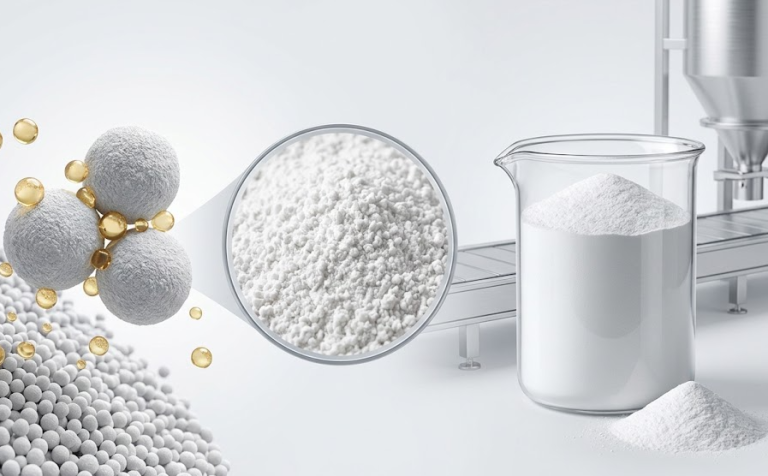
User needs -> measurable outcomes. Want silky skin, less flash, or longer wear? Target an amorphous silica with specific BET surface area and median particle diameter. Want instant free-flow for a powdered drink mix? Prioritize low bulk density and narrow particle distribution. Make a short spec sheet that ties a single user promise to 2–3 measurable silica attributes so teams don’t guess.
Formulation playbook — keep it simple and test fast
Prototype with base formulas and swap one silica variable per run. Track feel, spread, opacity, and stability. Use blind panels and instrument data — sebum adsorption, rheology curves, and accelerated humidity tests. If a formula flops, don’t blame “the market”; change one factor and retest. Speed beats perfection when you’re validating user hypotheses.
Supply and sourcing — what to ask suppliers
Ask for test certificates: particle size distribution, loss on drying, pH in suspension, and residual solvents or heavy metals. Confirm whether the silica is hydrophobic-treated or untreated, and what coupling agents were used. Ask about batch-to-batch variability and minimum order sizes. If your customer base scales fast, lock in consistency before you scale packaging designs.
Experience, expertise, and a real-world anchor
I’ve worked with product teams that pivoted entire lines after consumer sensory sessions ran in Seoul’s K‑beauty testing labs — that market’s strict standards taught them fast how silica grades change finish and longevity. That kind of hands-on testing validates safety and performance; also look up formulations citing silica powder in cosmetics for reference on common grade uses. Use that evidence to argue for specific material specs rather than vague feel descriptions.
Regulatory safety and documentation — keep legal chill
Match your grade to regulatory uses: food-grade vs cosmetic-grade demand different documentation. Keep SDS, certificates of analysis, and migration/exposure test results handy. Don’t assume a supplier’s claim — verify with third-party lab data when you’re making consumer health promises.
Common pitfalls teams trip on
Trying to be everything to everyone. Mixing multiple silica grades without a purpose. Skipping real-user sensory checks because “lab feels fine.” Over-spec’ing a grade that blows up costs. Underestimating humidity or oil load in the field. Keep fixes small and data-driven: one change, one test, one verdict.
Alternatives and when to pivot
If silica’s tradeoffs block your product goals, consider alternatives: starches or clay for absorbency, polymethylsilsesquioxane for soft-focus effects, or treated silica blends for hydrophobicity. Try small A/B runs to compare tactile and stability outcomes. If an alternative wins user panels and meets specs, pivot — don’t stick to a material out of pride.
Ship product thinking that users feel
Ship clarity: every silica decision ties back to a user promise and a test you can run. Start with a concise spec sheet, prototype fast, validate with users, and lock supply that matches your test results. When teams do that, the product doesn’t just look engineered—it performs for people. That’s why partnering with a consistent supplier becomes part of the product design, like the way designers lean on trusted sources such as JSJ Silica for repeatable grades that match the specs you validated with users.